
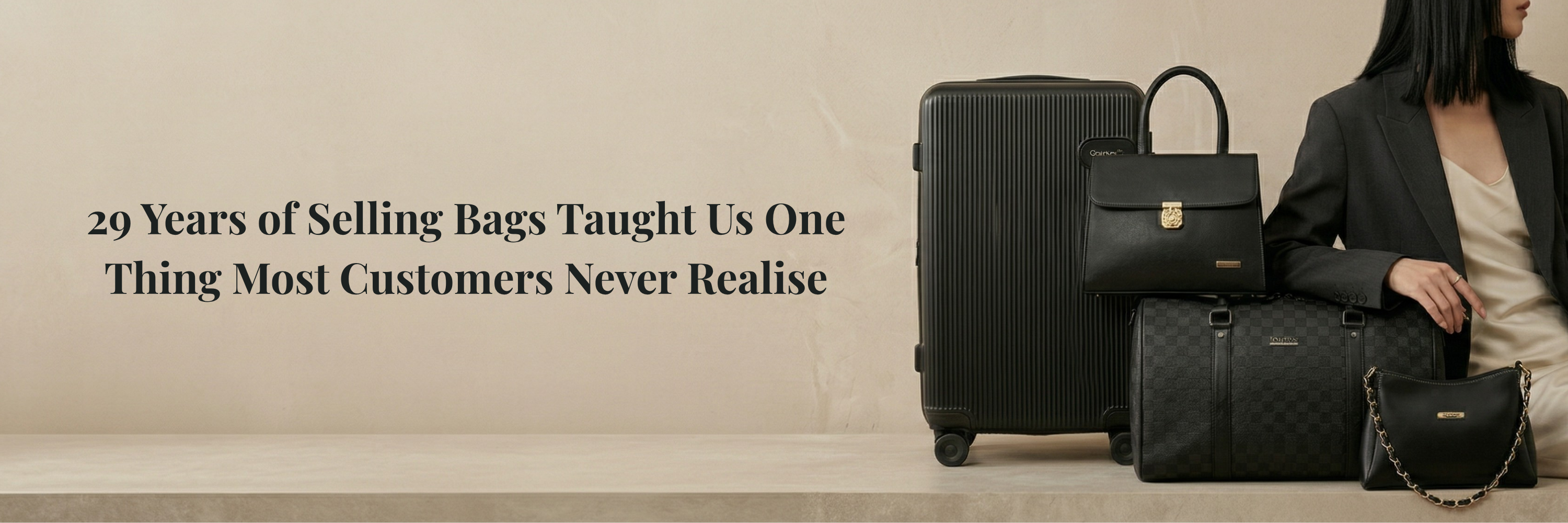
A manufacturer's honest confession about what actually makes a bag worth buying.
By Orange Bags · March 2026 · 7 min read
We have been in this industry for 29 years.
Wholesale. Retail. Manufacturing. We have seen bags made well and bags made badly. We have watched trends come and go. We have spoken to thousands of customers — directly, through retailers, through the quiet evidence of what comes back and what does not.
And after all of it, one thing stands out as the thing most customers never realise when they buy a bag.
It is not about the brand name. It is not about the price. It is not even about the material, though material matters.
It is this:
Most people buy a bag for how it looks on the shelf. But they live with a bag for how it feels in the hand, on the shoulder, and at the bottom of a busy day.
Those are two completely different bags. And most of the market is only designed for the first one.
What We Mean by This
Walk into any store — online or offline — and bags are photographed to look their absolute best. Perfect light. Perfect props. Perfect angle that hides the slightly awkward strap attachment or the lining that will start peeling by month four.
The bag looks good. You buy it. You use it for three weeks and something starts to feel slightly off. The zipper catches. The strap digs. The bottom loses its shape. The lining starts to separate at the corner.
None of this was visible in the photo.
We know this because we have been on both sides of it. We have made bags. We have sold bags. We have seen which ones come back and which ones do not. And the difference is almost never about how they looked. It is always about decisions that were made during manufacturing that no customer ever sees.
The Three Decisions That Actually Matter
After 29 years, we have narrowed it down to three things that separate a bag that lasts from one that does not.
The zipper.
This sounds small. It is not. A bad zipper is the first thing that fails on any bag, and it sets the tone for everything else. We test our zippers thousands of times before a bag goes into production. Not because we are obsessive — because we have seen what happens when you do not. A zipper that catches once will catch every time. A zipper that feels slightly wrong when you first use it will feel worse in six months. We would rather reject a sample over a zipper than sell a bag we cannot stand behind.
The lining.
Nobody sees the lining when they buy a bag. This is exactly why so many brands cut corners on it. Poor lining material starts to separate, peel, and leave residue on everything inside the bag within months of regular use. We use lining material we would be comfortable showing you. Because the inside of a bag tells you everything about how much a brand respects the person carrying it.
The strap construction.
A strap that is attached well will outlast the bag. A strap that is attached poorly will be the reason the bag becomes unusable. The difference in manufacturing cost between a well-attached strap and a poorly-attached one is sometimes as little as twenty rupees. But to the person carrying it, the difference is everything. We have never cut this corner. We never will.
Why Most Brands Do Not Tell You This
Because it is uncomfortable.
Admitting that manufacturing decisions affect the life of a bag means admitting that some bags are made to be replaced. And a customer who replaces their bag every year is more profitable than one who buys once and uses it for five years.
We have built our entire business on the opposite belief.
Our wholesale customers kept reordering for 29 years not because we were the cheapest option. Because the bags they ordered came back to them as complaints far less often than bags from other suppliers. Quality is not a moral position for us. It is the only business model that has ever made sense.
A customer who loves their bag tells three people. A customer whose bag fell apart tells thirty.
What to Look For When You Buy Any Bag
Pull the zipper ten times before you decide. It should move smoothly every single time with no catching.
Look inside the bag, not just outside. The lining should be clean, even, and attached at every corner.
Hold it by the strap and give it a firm tug. A well-constructed bag will not flex at the attachment point.
Feel the bottom. It should be firm enough to hold its shape when set down, but not so rigid it feels cheap.
Smell it. Seriously. A bag with good material has a clean, subtle smell. A bag with poor synthetic material often has a strong chemical smell that does not go away.
These five things take thirty seconds. They will save you from buying a bag that looks beautiful today and disappoints you in three months.
Why We Are Telling You This
Because we make bags that pass every one of these tests.
And because we believe that a customer who knows what to look for will always choose quality over the illusion of it.
We are not asking you to take our word for it. We are asking you to use the checklist. On our bags. On every bag you ever consider buying.
If we are right about our own product — and after 29 years, we believe we are — the bags will speak for themselves.
They always have.
We built Orange Bags on one principle: make something worth carrying. Everything else follows from that.
with love, Orange 🧡


Leave a comment
This site is protected by hCaptcha and the hCaptcha Privacy Policy and Terms of Service apply.